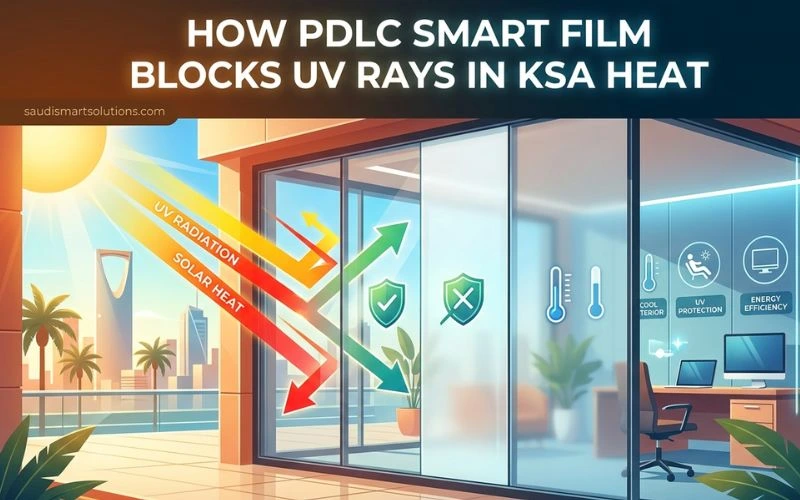
Saudi Arabia’s climate is one of the most punishing on the planet. With summer temperatures routinely exceeding 45°C and UV index levels that rank among the highest globally, protecting building interiors from solar radiation is not a luxury, it is a structural and health necessity. PDLC (Polymer Dispersed Liquid Crystal) smart film has emerged as one of the most effective modern solutions for this challenge, offering dynamic UV protection that traditional glazing simply cannot match.
What Is PDLC Smart Film?
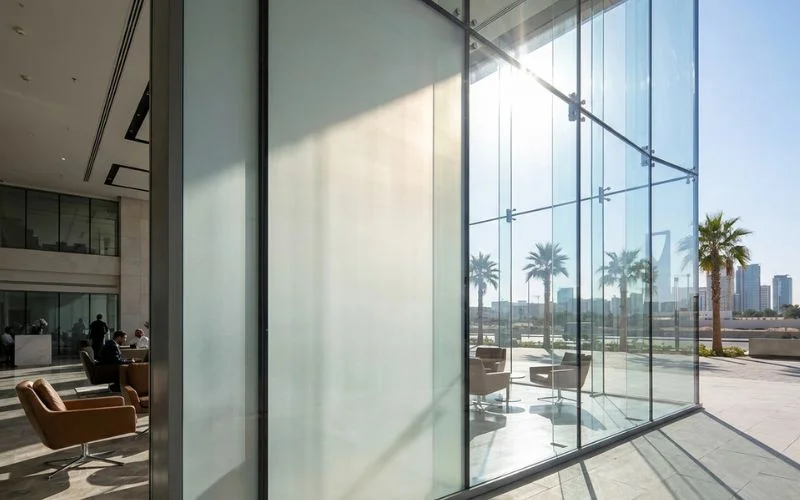
PDLC smart film is a switchable technology applied directly to existing glass surfaces. It consists of a liquid crystal layer sandwiched between two conductive polymer films. When an electrical current is applied, the liquid crystals align and the film becomes transparent. When the current is switched off, the crystals scatter, turning the surface opaque or frosted.
Beyond its well-known privacy switching capability, PDLC smart film provides consistent UV ray filtration regardless of its transparency state. This makes it highly relevant for KSA buildings where UV exposure through glass is a year-round concern, not just a summer issue.
Ready to protect your space from KSA’s harsh UV rays? Contact Saudi Smart Solutions today.
The UV Problem in KSA Buildings
The Kingdom of Saudi Arabia sits within one of the world’s highest solar irradiance zones. Standard clear glass transmits up to 90% of visible light and a significant portion of UV-A and UV-B radiation. Over time, this has serious consequences:
- Interior fading: Furniture, flooring, carpets, and wall finishes degrade rapidly under UV exposure
- Heat gain: UV and infrared radiation combined drive up indoor temperatures, increasing HVAC load
- Health risks: Prolonged UV exposure inside buildings contributes to skin damage, particularly in spaces like schools, offices, and clinics
- Energy loss: Higher cooling demand directly translates to higher utility bills, which remain a major overhead cost for commercial and residential buildings in KSA
When UV penetration is this aggressive, passive solutions like curtains or standard tinted glass only solve part of the problem. PDLC smart film addresses it at the glazing level itself.
How PDLC Smart Film Filters UV Rays
PDLC smart film typically blocks 99% of UV-A and UV-B rays in both its transparent and opaque states. This is achieved through the film’s multi-layer construction, which includes UV-absorbing interlayers that intercept radiation before it enters the interior space.
Unlike tinted glass, which reduces visible light transmission as a trade-off for heat control, PDLC smart film maintains optical clarity while still filtering out the harmful spectrum. This is a critical advantage in KSA, where natural light is abundant and reducing it entirely would increase reliance on artificial lighting, counterproductive from both a comfort and energy standpoint.
If you are weighing your glazing options, it is worth reading a direct comparison between smart film and tinted glass for Saudi buildings before making a final decision.
Solar Heat Reduction and Energy Efficiency
UV filtration is closely tied to solar heat gain control. PDLC smart film significantly reduces the Solar Heat Gain Coefficient (SHGC) of a glazed surface, meaning less solar energy enters the building as heat. In KSA’s climate, this directly reduces the workload on air conditioning systems.
Studies on smart glass and film technologies have shown that buildings using electrochromic and PDLC glazing systems can reduce cooling energy consumption by 20–40% depending on orientation, building type, and usage patterns. For large commercial buildings in Riyadh, Jeddah, or Dammam, where glass facades are architecturally common, this translates to significant annual savings.
For homeowners considering this upgrade, the smart film options available for luxury villas in Riyadh in 2026 cover a range of configurations suited to different facade sizes and interior goals.
Applications Across KSA Building Sectors
PDLC smart film is being specified across a wide range of building types throughout the Kingdom:
Residential: Villas and apartments use smart film on west and south-facing windows to reduce afternoon heat load while preserving views.
Commercial: Office buildings apply it to conference rooms and executive suites for combined privacy and UV protection without compromising natural light.
Healthcare: Clinics and hospitals use it in patient areas and consultation rooms where UV exposure and privacy are both critical concerns.
Education: Schools are increasingly specifying UV-filtering glazing solutions. The reasons Saudi schools are installing smart glass now extend beyond energy savings to student health and classroom comfort.
Hospitality: Hotels across Riyadh and the Red Sea coast are integrating smart film into guest rooms and lobbies to protect high-value interiors and reduce operational energy costs.
PDLC Smart Film vs. Traditional UV Solutions
Not all glazing solutions perform equally in KSA’s extreme UV environment. Standard clear glass offers almost no UV protection and allows significant heat penetration throughout the day. Tinted glass provides moderate filtration but permanently darkens interior spaces, which increases dependence on artificial lighting. Solar window film blocks UV effectively but offers no privacy control or switchability.
PDLC smart film stands apart by combining 99% UV blockage, dynamic privacy switching, and minimal visual impact in a single retrofittable solution. For a detailed side-by-side breakdown, a comparison of smart glass vs smart film for KSA homes helps clarify which format suits different building types and budgets.
Installation and Retrofitting in Existing Buildings
One of PDLC smart film’s most practical advantages in KSA is that it can be applied to existing glass without replacing entire window units. This retrofitting capability makes it cost-effective for older commercial buildings and residential properties that were glazed before UV-protective technologies became standard.
According to the International Window Film Association, professionally installed UV-blocking window films can extend the lifespan of interior furnishings by up to five times compared to unprotected glass, a compelling return on investment for any property owner in a high-UV environment.
Conclusion
KSA’s heat and UV intensity demand more than conventional glazing solutions. PDLC smart film offers a technically advanced, aesthetically clean, and energy-efficient method of blocking harmful UV rays while preserving the visual openness that modern architecture demands. Whether applied in a luxury villa, a commercial tower, or a school building, it represents a smart, long-term investment in building performance and occupant well-being.