
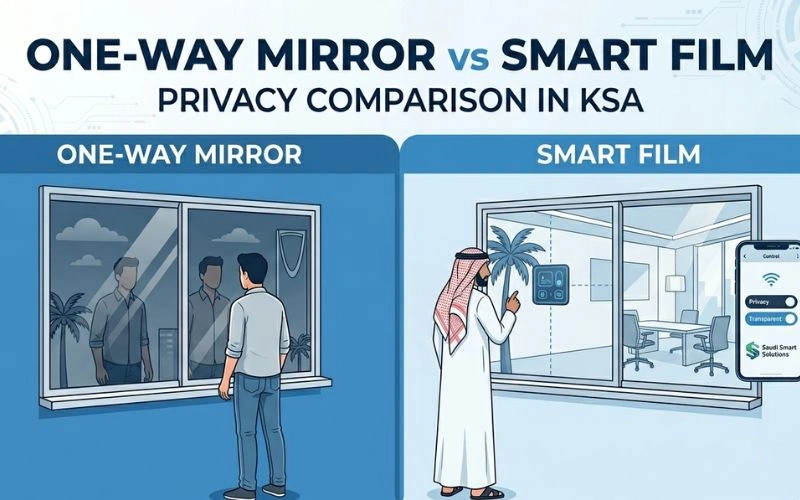
Privacy sits at the heart of Saudi Arabian culture, in homes, offices, clinics, and commercial spaces alike. As the Kingdom modernises rapidly under Vision 2030, the demand for sophisticated, reliable privacy solutions in KSA has never been greater. Two options frequently come up in this conversation: the traditional one-way mirror and the increasingly preferred smart film. Both promise privacy, but they work in fundamentally different ways and perform very differently in Saudi Arabia’s unique environment. This guide breaks down exactly how they compare so you can choose the right solution with confidence.
Understanding One-Way Mirrors: Functionality and Applications
A one-way mirror, also called a two-way mirror, works on the principle of light differential. It allows a person on the darker side to see through, while reflecting light back to the brighter side, creating the illusion of a standard mirror. This effect only works reliably when there is a significant difference in light levels between the two sides.
One-way mirrors are commonly used in police interrogation rooms, retail security booths, observation areas in research facilities, and some office partitions. In residential settings, they are occasionally installed in entrance foyers or boundary walls for security monitoring. However, their functionality is strictly passive and entirely dependent on lighting conditions, a major limitation in real-world applications. If you are currently using or considering other window treatments for privacy, our comparison of smart film vs blinds covers how these options stack up against each other in Saudi Arabia, and our smart film vs curtains guide covers fabric-based treatments specifically.
Smart Film Technology: How It Works for Privacy
Smart film, powered by PDLC (Polymer Dispersed Liquid Crystal) technology, takes an entirely different and far more advanced approach. When electricity is applied, liquid crystal molecules align and the film becomes fully transparent. When power is cut, the crystals scatter and the glass instantly turns frosted-opaque, delivering complete smart film for privacy on demand in any lighting condition, at any time of day.
Applied directly to existing glass surfaces, smart film can be controlled via a wall switch, remote control, smartphone app, or voice assistant. It connects directly to smart home systems with no structural changes required. Given Saudi Arabia’s extreme temperatures, it is also worth understanding how this technology holds up year-round. Our dedicated guide on smart film for hot climate explains exactly why PDLC film is engineered to perform in the Kingdom’s harsh conditions.
Not sure which privacy solution is right for your space? Our experts are ready to help.
Privacy Comparison: One-Way Mirrors vs Smart Film
This is where the differences become most critical.
Daytime privacy: One-way mirrors fail in daylight. When both sides are equally lit, which is almost always the case outdoors in Saudi Arabia, the mirror effect disappears entirely, leaving both sides visible. Smart film delivers full opacity regardless of lighting conditions.
Night-time privacy: One-way mirrors reverse at night. If the inside of a room is brighter than the outside, the person inside becomes visible. Smart film remains consistently frosted whenever switched off, day or night.
Heat and climate performance: Saudi Arabia’s summers push temperatures past 45°C. One-way mirrors are standard glass and offer no heat reduction whatsoever. Smart film actively blocks solar heat gain and filters up to 99% of UV rays, protecting interiors year-round.
Durability: One-way mirror coatings degrade under prolonged UV exposure and extreme heat, conditions that are constant across KSA. Smart film is engineered specifically for demanding climates with a lifespan exceeding 10 years.
Control and flexibility: One-way mirrors are permanently fixed. Once installed, there is no switching between transparent and private. Smart film gives you instant, switchable control at any moment.
Advantages of Smart Film Over One-Way Mirrors in Saudi Arabia
For the specific challenges of the Saudi environment, smart film for privacy outperforms one-way mirrors across every meaningful measure. Our switchable privacy smart film is engineered specifically for these conditions:
- Climate resilience: Smart film is engineered to withstand extreme heat and intense UV radiation, conditions that degrade standard mirror coatings rapidly.
- Energy efficiency: Smart film reduces solar heat gain, cutting air conditioning costs by up to 40% in Saudi buildings.
- Consistent privacy: Unlike one-way mirrors, smart film works reliably in all lighting conditions without exception.
- Hygienic and dust-free: No fabric, no dust traps, and no periodic replacement cycles, making it ideal for both residential and commercial environments.
- Smart integration: Full compatibility with Alexa, Google Home, and Apple HomeKit for fully automated privacy scheduling.
According to research published by the American Institute of Architects, high-performance glazing and switchable film technologies are increasingly being specified in modern buildings for their combined privacy, thermal, and wellness benefits, trends now clearly visible in Saudi Arabia’s new construction landscape. For glass surfaces where opacity is preferred over the frosted look, our smart film vs frosted glass comparison explains the visual and performance differences.
Which Privacy Solution is More Suitable for Saudi Homes and Businesses?
For residential use: Smart film is the clear winner. It provides consistent privacy, integrates with home automation, and protects interiors from UV damage without any of the aesthetic or functional limitations of one-way mirrors. Before proceeding with any installation, our guide on smart film installation considerations walks you through everything you need to plan for in Saudi homes and commercial spaces.
For commercial offices: Smart film offers dynamic, switchable privacy for boardrooms, meeting pods, and glass partitions, something a fixed one-way mirror simply cannot provide.
For the hospitality sector: Saudi Arabia’s luxury hotel industry has been an early adopter of smart film technology. Our article on smart film for hotels details how properties across the Kingdom are using PDLC film to enhance guest privacy and improve interior aesthetics simultaneously.
For healthcare settings: Clinics and hospitals need instant, reliable privacy without the hygiene concerns fabric brings. Our guide on privacy without curtains covers how smart film is replacing curtains in these environments.
For security-focused applications: One-way mirrors retain limited relevance in dedicated observation or interrogation contexts where controlled lighting can be maintained. Outside of these niche scenarios, smart film is the more versatile and practical option for best privacy options in Saudi Arabia.
Cost Consideration: One-Way Mirrors vs Smart Film in Saudi Arabia
While one-way mirrors carry a lower upfront cost, their light-dependent limitations, coating degradation under the Saudi sun, and complete absence of energy-saving benefits make them a poor long-term investment. Smart film’s higher initial cost is offset by energy savings, zero maintenance, and a lifespan that is two to three times longer. It is also worth comparing smart film against other budget-friendly alternatives. Our breakdown of smart film vs window tint provides a clear cost and performance comparison for KSA properties.
A report from the International Energy Agency highlights that smart glazing technologies in hot-climate buildings deliver some of the strongest returns on investment of any building upgrade, further reinforcing the financial case for smart film in Saudi Arabia.
Conclusion: The Future of Privacy Solutions in Saudi Arabia
The comparison between one-way mirrors and smart film ultimately reflects a broader shift in how Saudi Arabia approaches modern living and working environments. One-way mirrors are a passive, light-dependent technology with no flexibility, no climate benefits, and no smart home compatibility. Smart film for privacy is an active, intelligent, and future-ready solution that performs consistently in any condition, protects against Saudi Arabia’s intense heat and UV radiation, and integrates with the smart home systems that KSA residents increasingly demand.
For homes, offices, hospitals, schools, hotels, and commercial spaces across the Kingdom, smart film is not just the better choice. It is the only choice built for the future.
Frequently Asked Questions
Does smart film work for privacy both day and night?
Yes. Unlike one-way mirrors which depend entirely on lighting conditions, smart film switches to fully frosted-opaque on demand, delivering reliable privacy in all lighting conditions, 24 hours a day.
Can one-way mirrors be used in high-traffic commercial areas?
One-way mirrors can be installed in commercial spaces but only function as privacy solutions when there is a strong and consistent light differential between the two sides, a condition rarely maintained in busy, real-world environments.
How quickly does smart film switch from clear to opaque?
Smart film transitions in milliseconds, virtually instantaneous, making it ideal for spaces where immediate privacy is required, such as meeting rooms, medical consultation areas, or residential bathrooms.
Is smart film suitable for Saudi Arabia’s extreme heat?
Absolutely. Saudi Smart Solutions’ PDLC smart film is specifically engineered for high-temperature climates, offering 99% UV protection and up to 40% reduction in solar heat gain, making it one of the most climate-appropriate window solutions available in KSA.
Can smart film replace one-way mirrors in security applications?
In most real-world security contexts, yes. Smart film can be switched to transparent for observation and opaque for concealment, offering greater flexibility than a fixed one-way mirror. For dedicated interrogation or research observation rooms with controlled lighting, a one-way mirror may still serve a niche role.