The modern Saudi office is changing fast. Driven by Vision 2030’s push toward a more diversified, knowledge-based economy, businesses across Riyadh, Jeddah, and Dammam are investing heavily in workspace design, and the question of how to divide office space is now more relevant than ever. Traditional drywall and fixed partitions have served offices for decades, but a growing number of KSA businesses are making the switch to smart glass, and the reasons go well beyond aesthetics.
Choosing between smart glass and traditional partitions is not just a design decision. It affects privacy, natural light, energy efficiency, flexibility, and long-term operating costs. For office managers and property developers working in Saudi Arabia’s competitive commercial real estate market, getting this choice right matters.
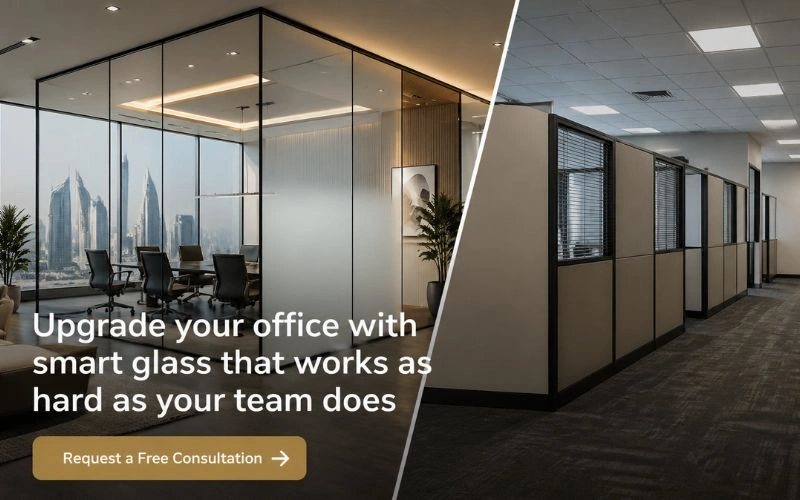
Upgrade your office with smart glass that works as hard as your team does.
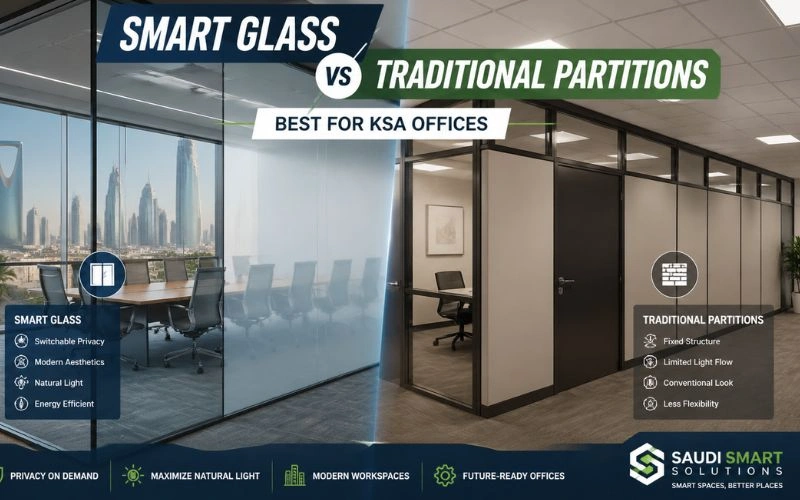
Traditional partitions, whether drywall, wood, or standard frosted glass, offer a familiar solution, but they come with fixed limitations. Once installed, they are difficult to reconfigure, they block natural light from reaching interior workspaces, and they offer no flexibility in terms of privacy levels throughout the day. Smart glass, by contrast, gives office managers complete control over transparency at the press of a button, switching between fully clear and fully opaque in seconds.
What Is Smart Glass and How Does It Work in an Office Setting?
Smart glass uses PDLC (Polymer Dispersed Liquid Crystal) smart film technology to switch between transparent and opaque states on demand. In an office environment, this means a glass partition wall or meeting room enclosure can be completely open and light-filled during regular working hours, then turned fully private for a confidential meeting in an instant.
Smart Glass vs Smart Film: Understanding the Options
Before comparing smart glass to traditional partitions, it is worth clarifying one important distinction. Smart glass vs smart film are two different product formats that use the same underlying PDLC technology. Smart glass comes as pre-laminated panels used in new construction or full glass replacement projects. Smart film is a retrofit solution applied directly to existing glass surfaces. Both deliver the same switchable privacy functionality, and both are viable for KSA office environments depending on whether you are building new or upgrading an existing space.
The Core Limitations of Traditional Office Partitions
Traditional partitions have defined office layouts across Saudi Arabia for years, but the shortcomings become obvious when placed next to modern smart alternatives.
Fixed, Inflexible, and Light-Blocking
A drywall or solid partition is permanent. Reconfiguring office layouts means construction work, dust, downtime, and significant cost. For businesses that need to scale teams, reorganize departments, or adapt to hybrid work models, which are increasingly common across KSA, this inflexibility is a real operational problem.
Fixed partitions also block natural light from penetrating deep into office floors. Research consistently shows that access to daylight improves employee productivity, mood, and focus. When interior workspaces are cut off from windows by opaque walls, businesses pay more for artificial lighting while simultaneously reducing the quality of the work environment.
Standard frosted glass partitions solve the light problem partially, but they offer no flexibility, they are either always private or always transparent, with no middle ground.
How Smart Glass Outperforms Traditional Partitions for KSA Offices
Smart glass addresses every major limitation of traditional partitions while adding capabilities that fixed walls simply cannot offer.
On-Demand Privacy Without Sacrificing Light
The defining feature of smart glass partitions is switchable privacy, delivered through switchable privacy smart film. During open collaboration sessions, the glass stays fully transparent, keeping the office feeling open, airy, and connected. When a meeting requires confidentiality, a client presentation, an HR discussion, or a board session, the glass turns opaque instantly. No curtains, no smart film vs curtains trade-offs needed, and no compromise on natural light the rest of the time.
Energy Efficiency in Saudi Arabia’s Climate
Smart glass partitions do more than manage privacy, they also contribute to energy savings. By allowing natural light to flow freely through the office floor when in transparent mode, they reduce the need for artificial lighting during working hours. This is especially valuable in Saudi Arabia, where electricity costs for commercial properties are a significant line item. Interior spaces that would otherwise rely entirely on overhead lighting can benefit from natural daylight reaching further into the floor plan.
Flexible Office Design for Growing Businesses
Unlike fixed walls, smart glass partition systems can be reconfigured as business needs change. For the growing number of Saudi companies scaling operations under Vision 2030, this flexibility has direct financial value. Reconfiguring smart glass does not require construction work, minimizes downtime, and preserves the investment already made in the original installation.
Where Smart Glass Delivers the Most Value in KSA Offices
Not every part of an office benefits equally from smart glass. The highest-value applications tend to cluster around spaces where privacy and openness need to coexist.
- Executive meeting rooms that double as open collaboration spaces
- HR and legal consultation areas requiring confidentiality on demand
- Reception and waiting areas that benefit from an open, modern aesthetic
- Open-plan offices with designated quiet zones that shift function throughout the day
- Client-facing showrooms and boardrooms where presentation quality matters
The same PDLC technology used in Saudi offices has been applied with strong results in other high-demand sectors. Hotels in Saudi Arabia use smart film extensively for guest room privacy, and the healthcare sector has adopted it to replace curtains in clinical settings, you can read more about smart film for hospitals and clinics and the specific privacy benefits it delivers without any physical divider at all.
Cost Comparison: Smart Glass vs Traditional Partitions Over Time
The upfront cost of smart glass partitions is higher than standard drywall or basic solar control film alternatives. That is a straightforward fact. However, the total cost of ownership over three to five years tells a different story.
Traditional partitions require professional contractors for any layout change. Reconfiguration costs add up quickly for businesses that grow or reorganize. Smart glass involves no such recurring cost. Add in savings on artificial lighting, reduced AC load from better daylight distribution, and the productivity benefits of a better work environment, and the financial case for smart glass strengthens considerably over time.
For a detailed breakdown of what to evaluate before making a final decision, this guide on before installing smart film covers the key technical and financial factors specific to the Saudi market.
The Standard for Modern Saudi Workspaces
Saudi Arabia’s commercial real estate sector is undergoing a genuine transformation. New office towers in Riyadh’s King Abdullah Financial District, mixed-use developments in Jeddah, and expanding business hubs in Dammam are all setting higher expectations for workspace quality. Smart glass partitions are becoming a baseline feature in premium KSA office environments, not a novelty, but a standard.
According to JLL’s Global Office Fit-Out Costs Guide 2026, building adaptability into office design and delivery is one of the top priorities occupiers are being advised to plan around this year, and that trend is accelerating across the Middle East. Businesses investing in smart office infrastructure today are positioning themselves for lower operational costs, better talent retention, and stronger commercial appeal in a competitive leasing market.
Saudi Smart Solutions installs smart glass and smart film partition systems across all major KSA cities, with professional fitting, custom sizing, and a full 5-year warranty on every project. The process is clean, fast, and purpose-built for Saudi Arabia’s architectural and climate demands.
Frequently Asked Questions
Is smart glass more expensive to install than a drywall partition?
Yes, the upfront cost is higher than standard drywall or basic glass. Over three to five years, though, the absence of reconfiguration costs, lower lighting and AC load, and added flexibility typically close much of that gap.
Can smart glass partitions be retrofitted into an existing office?
Yes. Smart film is applied directly to existing glass surfaces as a retrofit, while smart glass panels are used for new construction or full glass replacement. Both options suit KSA offices depending on whether the space is being built new or upgraded.
How long does a smart glass partition installation take?
Installation timelines depend on the size and number of partitions, but professional fitting is designed to minimize disruption to daily office operations compared with construction-based partition changes.