

Saudi Arabia’s shopping malls are among the most visited destinations in the region. From the expansive Mall of Arabia in Jeddah to Riyadh Park and the Red Sea Mall, these spaces serve millions of shoppers every year and compete fiercely for footfall, brand visibility, and customer loyalty. As mall operators modernise their facilities to meet rising expectations, smart film for displays has emerged as one of the most impactful upgrades available today. It transforms ordinary glass surfaces into intelligent, dynamic, and energy-efficient assets, delivering benefits that touch every dimension of mall operations, from retail aesthetics and customer engagement to energy management and privacy control.
What is Smart Film and How Does It Work for Displays?
Smart film is a PDLC (Polymer Dispersed Liquid Crystal) technology that is applied directly onto existing glass surfaces. When an electrical current is applied, the liquid crystal molecules within the film align and the glass becomes fully transparent. When power is removed, the molecules scatter and the glass switches instantly to a frosted-opaque state. This transition happens in milliseconds and can be triggered by a wall switch, remote control, touch panel, smartphone app, or automated scheduling system.
For shopping malls, this technology opens up entirely new possibilities for retail displays, storefront privacy, projection surfaces, and interactive customer experiences. Before any large-scale mall installation, our guide on smart film installation considerations provides a detailed checklist of technical and practical factors that mall managers should review before proceeding with a project.
Enhancing Customer Experience: Smart Film for Interactive Displays
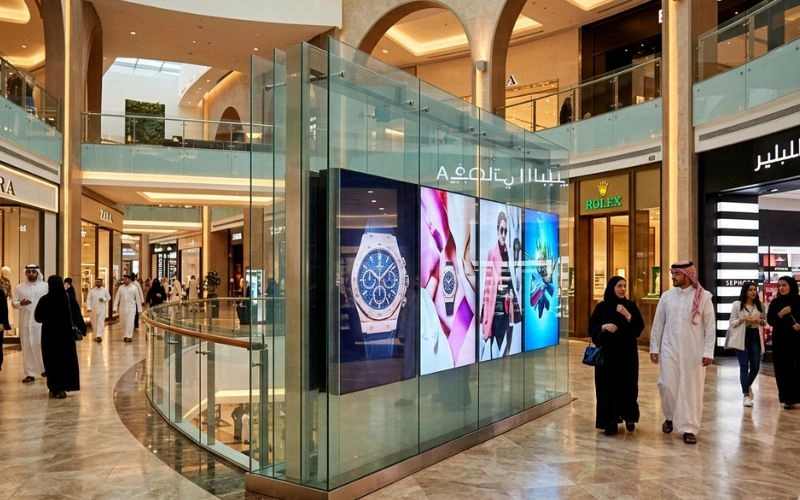
One of the most compelling applications of smart film for displays in shopping malls is its use as an interactive, switchable projection surface. When the film is in its opaque state, it becomes a high-quality rear-projection screen capable of displaying digital advertising, promotional content, product launches, and brand campaigns directly on storefront glass. When switched to transparent, the display disappears entirely, returning the glass to its normal state.
This dynamic capability allows retailers to alternate between open-view window displays and full-screen digital media without any additional screens, projectors mounted externally, or permanent visual obstructions. Major international retail brands operating in KSA malls have adopted this approach to create immersive shopfront experiences that capture shopper attention and drive foot traffic into stores. According to research from Nielsen, dynamic in-store displays generate significantly higher customer engagement than static visuals, reinforcing the commercial case for smart film in high-footfall retail environments.
Transform your mall displays with Saudi Arabia’s most trusted smart film experts.
Smart Film for Energy Efficiency in Shopping Malls
Shopping malls in Saudi Arabia operate enormous air conditioning systems year-round, with energy bills representing one of the largest operational costs any mall management company faces. Large glass facades, skylights, and floor-to-ceiling storefront windows allow significant solar heat gain throughout the day, forcing HVAC systems to work harder and consume more electricity to maintain comfortable indoor temperatures.
Smart film directly addresses this challenge by blocking up to 99% of UV rays and substantially reducing solar heat gain through glass. For a mall with hundreds of square metres of glass surface area, this translates into measurable reductions in cooling energy demand and monthly utility costs. Our dedicated resource on smart film for Saudi climate provides specific performance data on how PDLC film holds up under the Kingdom’s extreme summer temperatures, making it a highly relevant read for facility managers overseeing large commercial properties.
The International Finance Corporation has noted in its green building guidelines that dynamic glazing technologies including smart film are among the highest-impact interventions available for reducing energy consumption in commercial buildings in hot climates, a finding directly applicable to KSA’s major mall properties.
Privacy and Branding
Beyond interactivity and energy efficiency, retail display solutions in KSA increasingly rely on smart film for controlled privacy and dynamic branding. Fitting rooms, VIP retail areas, jewellery displays, and luxury brand boutiques all benefit from the ability to switch between open and private states on demand. Smart film allows high-end retailers to create an exclusive, by-appointment atmosphere simply by activating opaque mode, without any permanent physical partitions or fabric screens. The same principle applies beyond retail: our piece on smart film for hospitals and clinics shows how the same on-demand privacy control is used in healthcare settings without curtains.
From a branding perspective, frosted smart film can also be custom-printed with logos, patterns, and graphics in its opaque state, giving mall operators and individual retailers a powerful tool for visual identity that doubles as a functional privacy screen. This dual purpose is one of the key reasons smart film is preferred over alternatives like blinds. Our comparison of smart film vs blinds details exactly why switchable film outperforms mechanical window treatments for both aesthetics and long-term reliability in commercial settings.
Case Studies
Across Saudi Arabia, mall operators and individual tenants are reporting strong results from smart film installations:
Luxury jewellery retailers in Riyadh malls have installed smart film on display cabinets and glass partitions, enabling them to switch to full privacy mode during after-hours stock management while maintaining a completely open, welcoming appearance during trading hours.
Food court areas with glass facades in Jeddah have used smart film to reduce afternoon sun glare and heat for diners seated near windows, improving comfort and encouraging longer dwell times without blocking natural light.
Anchor stores in major KSA malls have adopted smart film on entrance glass for seasonal campaign displays, using the opaque state as a rear-projection surface during product launches and switching back to full transparency once the campaign concludes. The same switchable-glass logic is reshaping office environments too, as covered in our article on smart glass vs traditional partitions in KSA offices.
The parallels with the hospitality sector are clear. Our article on smart film for hotels demonstrates how Saudi Arabia’s luxury hotel properties have achieved similar results with switchable film across guest-facing glass environments, offering useful reference points for mall operators considering large-scale adoption.
The contrast is clear. Curtains and blinds offer basic light blocking but bring significant maintenance requirements and offer no interactive display functionality. Smart film delivers privacy, projection capability, UV protection, and energy savings within a single, clean installation. For mall operators also considering window tinting as a cost-effective alternative, our comparison of smart film vs window tint explains why the switchable functionality of smart film delivers far superior commercial value over static tinting solutions.
While the upfront investment in smart film is higher than traditional options, the combination of eliminated maintenance, extended lifespan, and substantial energy savings produces a significantly stronger return on investment over the operational lifetime of a mall property. For large commercial installations covering hundreds of square metres, these savings compound significantly year on year.
Conclusion
Smart film is redefining what is possible inside Saudi Arabia’s shopping malls. It transforms glass from a passive architectural element into an active, intelligent asset that enhances customer experiences, supports retailer branding, controls energy costs, and provides privacy on demand. As KSA’s retail sector continues to modernise and competition for shopper attention intensifies, smart film for energy efficiency and display innovation will become a standard feature of forward-thinking mall design rather than a premium option.
For mall operators, retail tenants, and property developers across Riyadh, Jeddah, Dammam, and beyond, now is the ideal time to evaluate smart film as a core component of your facility upgrade strategy.
Frequently Asked Questions
Can smart film be used for large mall windows?
Yes. Smart film is custom-cut and manufactured to any dimension, making it fully suitable for the large glass facades, floor-to-ceiling storefronts, and skylights commonly found in Saudi shopping malls. Saudi Smart Solutions handles commercial projects of all scales across the Kingdom.
How does smart film improve mall aesthetics and energy efficiency?
Smart film eliminates the need for bulky curtains, blinds, and external screens while simultaneously blocking up to 99% of UV rays and reducing solar heat gain by up to 40%. The result is a cleaner, more modern interior appearance alongside significant reductions in air conditioning energy costs.
Can smart film be used as a projection screen in mall displays?
Yes. In its opaque state, smart film functions as a high-quality rear-projection surface, allowing retailers and mall operators to display digital content, brand campaigns, and promotional media directly on storefront glass without any additional external screens.
How long does smart film last in a high-traffic mall environment?
Saudi Smart Solutions’ PDLC smart film has a lifespan exceeding 10 years under normal commercial use and is backed by a comprehensive 5-year warranty on both the film and installation across all KSA projects.
Is smart film suitable for outdoor-facing mall glass?
Smart film is designed for interior glass surfaces. For outdoor-facing glass in mall facades, our team will conduct a full site assessment to recommend the most appropriate product configuration for your specific environmental and architectural conditions.