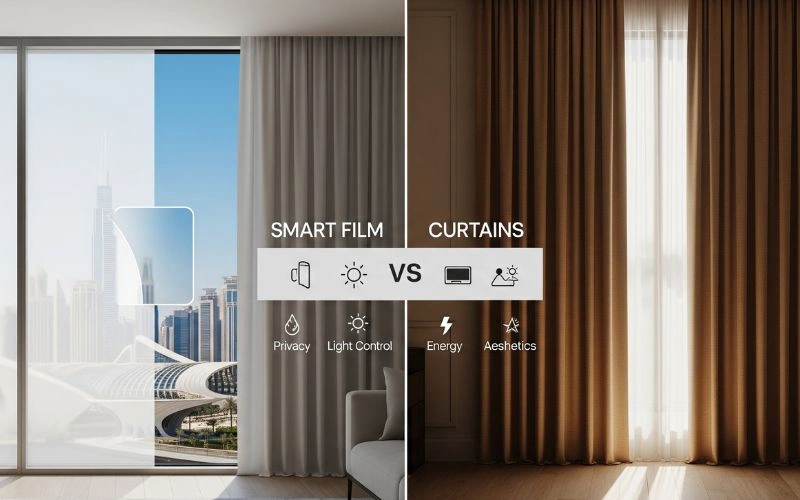
Privacy is not just a preference in Saudi Arabia, it is a cultural cornerstone. From luxury villas in Riyadh to corporate towers in Jeddah, homeowners and businesses consistently seek window solutions that deliver strong privacy, reliable heat control, and refined aesthetics. For decades, curtains dominated every interior. But as smart home technology reshapes modern Saudi living, smart film in Saudi Arabia has rapidly emerged as the superior alternative, one that is smarter, cleaner, and far better suited to the Kingdom’s extreme climate and contemporary design sensibilities.
This guide compares both solutions head-to-head so you can make the right decision for your home or business.
Smart Film vs Curtains: Key Differences in Functionality
At their core, both smart film and curtains are designed to control privacy and light. But the similarities end there.
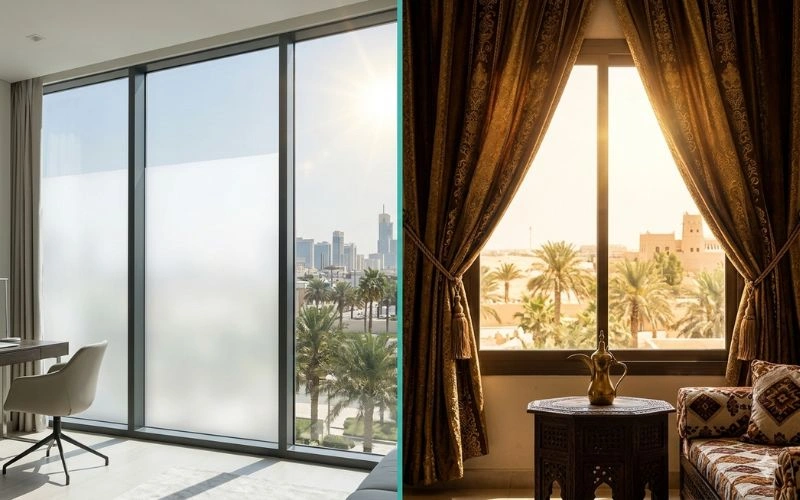
Smart film (PDLC technology) is applied directly onto existing glass and switches from fully transparent to frosted-opaque in milliseconds, at the tap of a button, a voice command, or a smartphone app. It blocks up to 99% of UV rays, reduces solar heat gain significantly, and maintains a clean, modern look at all times.
Curtains offer a binary experience, either fully open with no privacy, or fully closed with no light. They cannot filter UV rays effectively, and in Saudi Arabia’s dusty, sandy environment, they accumulate allergens rapidly and demand constant maintenance.
If you are also comparing other window solutions, our detailed guide on smart film vs blinds walks you through a direct side-by-side comparison for privacy and heat control.
Upgrade your windows with Saudi Arabia’s most trusted smart film experts.
Why Smart Film is Gaining Popularity in Saudi Arabia
The sharp rise in demand for smart film benefits across KSA is being driven by a combination of lifestyle, climate, and technology trends:
- Instant privacy via remote control, smartphone app, or voice assistant (Alexa, Google Home, Siri)
- 99% UV protection, shielding interiors, furniture, and occupants from Saudi Arabia’s punishing sunlight
- Up to 40% reduction in air conditioning costs, making it one of the most energy-efficient window solutions available
- Minimal maintenance, no washing, no dry cleaning, no replacement cycles
- Modern aesthetic that aligns perfectly with contemporary Saudi architecture and Vision 2030-inspired design
Research on energy-efficient window technologies from the U.S. Department of Energy confirms that advanced window films substantially reduce solar heat gain in hot climates, a critical advantage for buildings in Saudi Arabia where summer temperatures routinely exceed 45°C.
For those comparing the two most advanced window technologies available, our guide on smart glass vs smart film offers a detailed breakdown specific to KSA homes and commercial spaces.
The Drawbacks of Curtains in Saudi Arabia’s Climate
While curtains remain a familiar and accessible choice, their practical limitations in Saudi Arabia are hard to overlook:
- Dust accumulation is a persistent problem. Desert sandstorms and dry air mean curtain fabric traps dust, allergens, and pollutants, requiring frequent, costly washing cycles.
- Poor UV protection causes fabric to fade and deteriorate rapidly under direct Saudi sunlight, leading to replacement every two to three years.
- Heat retention near glass is a lesser-known but significant issue. Closed curtains trap hot air between the fabric and the window surface, actually increasing the burden on your air conditioning system.
- Aesthetic limitations make curtains increasingly mismatched with the clean, minimalist interiors favoured in modern Saudi homes and offices.
- Ongoing maintenance costs from dry cleaning bills to rod replacements and re-hanging, accumulate significantly over time.
As a curtains alternative, smart film eliminates every one of these drawbacks with a single, sleek installation directly on your existing glass.
Smart Film Applications in Saudi Homes and Businesses
The versatility of smart film in Saudi Arabia makes it the ideal solution across virtually every sector:
- Residential villas and apartments: Bedrooms, bathrooms, living room, glass partitions, and entrance doors
- Corporate offices: Conference room dividers, boardroom walls, executive suites, and reception partitions
- Healthcare facilities: Hospitals and clinics use smart film to create hygienic, dust-free privacy without fabric. Our page on smart film for hospitals covers how PDLC film is transforming medical privacy across the Kingdom
- Hotels and hospitality: Saudi Arabia’s luxury hospitality sector is rapidly adopting smart film for guest rooms, bathrooms, and spa facilities. Explore how smart film in hotels is elevating guest experiences across KSA
- Retail showrooms and banks: Dynamic transparency control creates engaging customer environments while protecting interiors from UV damage
The healthcare and hospitality industries in particular have seen dramatic results, with studies in the global hospitality sector noting that smart glass and film technologies improve guest satisfaction while simultaneously reducing a property’s energy footprint, a dual benefit that is especially valuable in high-utility Saudi environments.
Comparing Smart Film vs Curtains
The upfront cost of smart film is higher, but when you factor in energy savings, zero maintenance, and a lifespan that is two to three times longer than curtains, smart film delivers significantly stronger long-term ROI. Before planning your project, our comprehensive guide on installing smart film covers everything you need to consider, from surface types to control system options.
Which Is Better for You? Choosing the Right Solution for Your Needs
Your decision ultimately depends on your priorities:
- Short-term, low upfront cost? Curtains work, but expect recurring expenses.
- Long-term energy savings and zero maintenance? Smart film is the clear choice.
- Modern aesthetics for a new villa or office fitout? Smart film integrates seamlessly with contemporary Saudi interiors.
- Extreme heat and UV protection in KSA’s climate? Smart film outperforms curtains on every technical benchmark.
- Comparing all advanced window options? Our guides on smart film vs blinds and smart glass vs smart film give you a complete picture.
Conclusion: Why Smart Film is the Future of Privacy Solutions in Saudi Arabia
The comparison is decisive. Curtains have served Saudi homes for generations, but they are increasingly inadequate for the demands of modern KSA living, particularly against the Kingdom’s extreme heat, dust, and rapid architectural evolution. Smart film in Saudi Arabia delivers instant privacy, superior UV and heat protection, dramatic energy savings, and seamless smart home integration, all within a clean, maintenance-free installation.
As Saudi Arabia accelerates toward Vision 2030’s vision of modern, sustainable, and technologically advanced living environments, smart film is not just an upgrade, it is the future standard.
Frequently Asked Questions
Q: How long does smart film last in Saudi Arabia?
Smart film has a lifespan of over 10 years under normal use. Saudi Smart Solutions backs every installation with a comprehensive 5-year warranty.
Q: Can smart film block UV rays effectively?
Yes. Our PDLC smart film blocks up to 99% of UV rays, protecting furniture, interiors, and occupants from Saudi Arabia’s intense year-round solar radiation.
Q: Is smart film easy to maintain?
Smart film requires virtually no maintenance. A gentle wipe with a soft damp cloth is all that is needed, no washing, dry cleaning, or periodic replacement.
Q: Can smart film be installed on existing glass?
Yes. Our self-adhesive smart film is designed specifically for retrofitting onto existing glass surfaces with no glass replacement or structural changes required.
Q: Does smart film provide privacy during a power outage?
Yes. In its default unpowered state, PDLC smart film remains frosted and opaque, ensuring your privacy is always maintained even without electricity.