
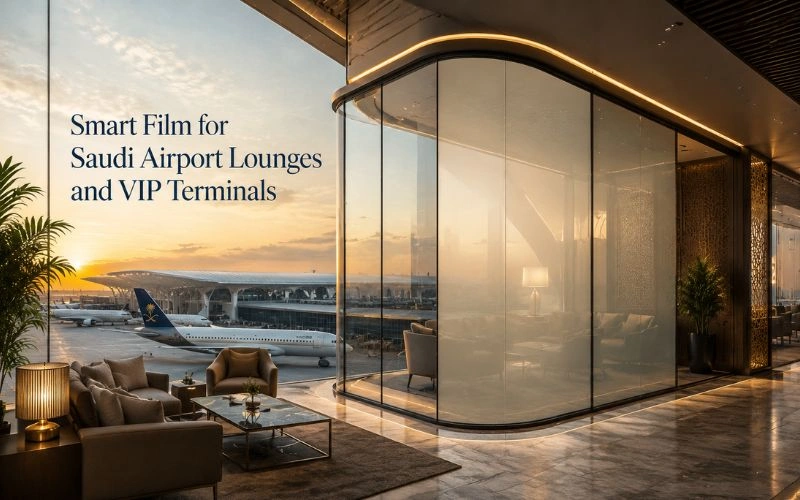
Saudi Arabia’s aviation sector is undergoing one of the most ambitious expansions in its history. With King Salman International Airport in Riyadh set to become one of the largest airports in the world, and major upgrades underway across Jeddah’s King Abdulaziz International Airport and Dammam’s King Fahd International Airport, the standard for passenger experience is being redefined from the ground up. At the center of that experience, particularly for business travelers, diplomats, and VIP guests, is the airport lounge and premium terminal environment.
First impressions in aviation hospitality carry enormous weight. A traveler who spends two hours in a lounge forms a lasting opinion of the airline, the terminal operator, and by extension, the Kingdom itself. Privacy, comfort, light management, and architectural elegance are not peripheral concerns in these spaces. They are the product being delivered. Smart film is emerging as the technology that allows Saudi airport lounges and VIP terminals to deliver all of these simultaneously, without the visual clutter of curtains, the inflexibility of fixed walls, or the maintenance burden of mechanical blinds.
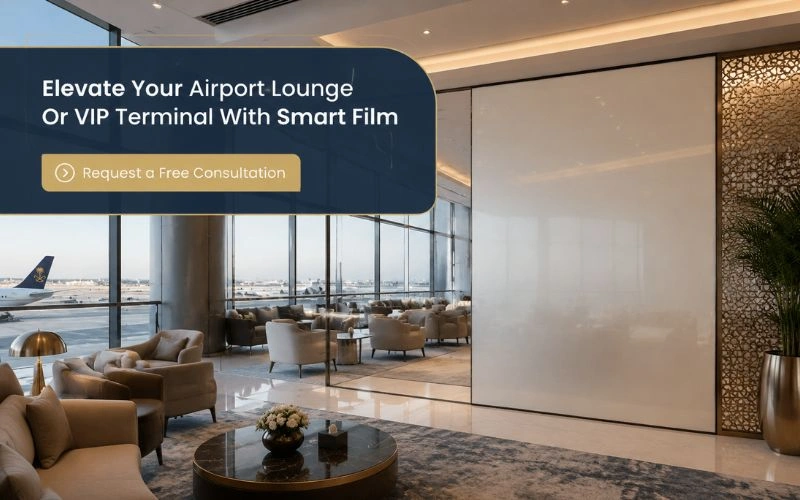
The challenge that airport lounges face is unique. They must feel open and spacious while simultaneously offering genuine privacy for guests who need to work, rest, or conduct sensitive conversations. They must manage intense natural light from large terminal glazing without blocking the architectural views that make premium spaces feel premium. And they must do all of this across a high-traffic, operationally demanding environment that runs around the clock, every day of the year. Smart film handles every one of these requirements within a single installation.
Why Airport Lounges and VIP Terminals Need Smart Film
The design requirements of an airport lounge sit at an unusual intersection: part hospitality venue, part workspace, part sanctuary. Getting the balance right between openness and privacy is the central challenge of every premium terminal environment.
The Privacy Problem in Open-Plan Lounge Design
Modern airport lounge design favors open, light-filled spaces with generous glazing and minimal visual obstruction. This creates an atmosphere of quality and space that guests respond positively to. But open design creates an immediate tension with privacy, business travelers on phone calls, dignitaries receiving briefings, and VIP guests expecting exclusivity all require seclusion that an open floor plan cannot naturally provide.
Traditional solutions compromise the design to solve the privacy problem. Curtains introduce fabric into a space that communicates luxury through hard materials and clean lines. Fixed frosted glass partitions solve privacy permanently but eliminate the flexibility to open spaces up during quieter periods. Standard window tint reduces glare but offers no privacy functionality and darkens the space regardless of conditions outside.
Smart film resolves this tension completely, delivering instant, switchable privacy on demand without altering the open aesthetic of the lounge during normal operation.
How Smart Film Transforms Lounge and Terminal Environments
PDLC smart film applied to the glass surfaces of an airport lounge creates a fully controllable privacy and light management system across the entire space. Individual zones can be managed independently, giving lounge operators precise control over every area of the floor plan.
On-Demand Private Suites Within an Open Lounge
One of the most powerful applications of smart film in airport lounges is the creation of glass-enclosed private suites that function as open seating when unoccupied and fully private spaces when in use. A VIP guest checking in triggers the glass to switch opaque, creating an instant private suite from what was moments before an open seating zone. When the guest departs, the space opens back up seamlessly. No staff intervention required, no furniture to rearrange, no curtain to draw.
This operational flexibility has direct commercial value. Lounge operators can monetize premium private spaces without dedicating permanent square footage to them, the same physical area serves both general lounge seating and bookable private suites depending on demand throughout the day.
Glare and Heat Control Across Terminal Glazing
Airport terminals in Saudi Arabia are characterized by expansive glazing that floods interiors with natural light, and in KSA’s hot climate, that glazing also delivers intense solar heat gain throughout the afternoon hours. Window-adjacent seating in lounges can become genuinely uncomfortable during peak sun hours, forcing guests away from premium window positions that should be the most desirable seats in the space.
Smart film’s solar control properties address this directly. By rejecting a significant percentage of solar radiation at the glass surface, smart film keeps window-adjacent zones comfortable throughout the day without blocking the architectural views that define the space. The film also blocks up to 99% of UV rays, protecting guests, furnishings, and interior finishes from long-term sun damage, a particularly important consideration in premium lounges where high-end furniture and materials represent a substantial capital investment.
Key Applications of Smart Film in Saudi Airport Environments
Smart film delivers value across multiple zones within an airport lounge or VIP terminal, each with a distinct operational benefit.
VIP and Royal Lounges
Saudi Arabia’s airports serve a significant volume of government officials, diplomats, royal family members, and high-net-worth international travelers. The privacy and security requirements of these guests go beyond standard lounge expectations. Smart film allows VIP suites and royal lounges to maintain complete visual separation from adjacent areas at all times, with instant opacity that requires no advance setup and leaves no visual indication of occupancy from the outside when engaged.
Business and First-Class Lounges
For airline business and first-class lounges, smart film enables the kind of flexible zone management that operators need to handle variable occupancy patterns across different times of day. Early morning departure rushes, midday quiet periods, and late-night arrival surges all create different spatial demands. A lounge with smart film-equipped glass partitions can reconfigure its effective layout in seconds without any physical intervention.
Prayer Rooms and Reflection Spaces
Saudi airport lounges universally include prayer rooms and quiet reflection areas, spaces that require guaranteed privacy and a calm, distraction-free environment. Smart film applied to the glass enclosures of these areas ensures consistent privacy without relying on curtains or blinds that require manual operation and ongoing maintenance. When comparing smart film against traditional blinds for this specific application, smart film’s reliability and zero-maintenance operation make it the clear operational choice for spaces that must function perfectly at all hours.
Boarding Gate VIP Holding Areas
VIP and diplomatic passengers often require separation from the general boarding process. Smart film on the glass enclosures of dedicated holding areas provides the visual separation required without the construction of permanent walls that would reduce terminal flexibility as gate assignments and aircraft types change over time.
Retail and Duty-Free Display Windows
Shopping malls across KSA have already demonstrated the commercial value of smart film for retail display management, and airport duty-free environments face identical challenges. Smart film on retail display windows allows operators to control what is visible to passing passengers, creating dynamic window reveals for promotional events, after-hours security opacity, and flexible visual merchandising without any physical shutter mechanism.
Operational Advantages That Matter at Airport Scale
Airport environments operate under constraints that most commercial properties do not face: around-the-clock operation, strict maintenance windows, high cleaning frequency, and the constant presence of high-value guests who notice every detail.
Smart film performs strongly against all of these operational requirements. It has no moving mechanical parts that wear out, no fabric components that absorb odors or require laundering, and no adjustment mechanisms that staff need to manage manually. The glass surface cleans with a standard wipe-down using the same products used on any other interior glazing.
For facilities managers overseeing airport lounge operations, PDLC film technology also offers an important advantage over tinted glass alternatives, it can be retrofitted to existing glass without panel replacement, which means installations can be completed during scheduled maintenance windows without requiring extended lounge closures or major structural work.
Smart Film in Saudi Hospitality: A Proven Track Record
Smart film’s performance in high-demand Saudi hospitality environments is well established. Hotels across Saudi Arabia have deployed PDLC technology extensively in guest rooms, executive floors, spa facilities, and lobby areas, environments that share many of the same operational demands as airport lounges. The technology has proven reliable under continuous use, high-traffic conditions, and the elevated cleaning frequency that premium hospitality environments require.
According to the General Authority of Civil Aviation’s Saudi Aviation Strategy, the Kingdom is targeting 330 million passengers annually across its airports by 2030 as part of its aviation expansion plan. As passenger volumes grow and competition between airlines and terminal operators intensifies, the quality of lounge and premium terminal environments becomes an increasingly important differentiator. Investing in smart film now positions operators to meet that rising standard before the volume arrives.
Planning a Smart Film Installation for Your Airport Facility
Airport lounge and terminal installations require careful planning around operational schedules, security clearance requirements, and the specific glass configurations of each zone. Every detail, from glass thickness and existing coatings to electrical supply routing and control system integration, affects the outcome of the installation. This guide on what to consider before installing smart film covers the full technical and commercial checklist that facility managers need to review before committing to a project.
Saudi Smart Solutions works with commercial facility operators, airline lounge managers, and terminal developers across all major KSA airports. Every installation is handled by certified technicians with experience in complex commercial environments, completed on schedules that minimize operational disruption, and backed by a comprehensive 5-year warranty. Products are sourced from manufacturers whose specifications are rated for Saudi Arabia’s high-UV, high-temperature climate conditions.
Ready to set a new standard for your airport lounge or VIP terminal? Book Your Free Site Assessment Today