
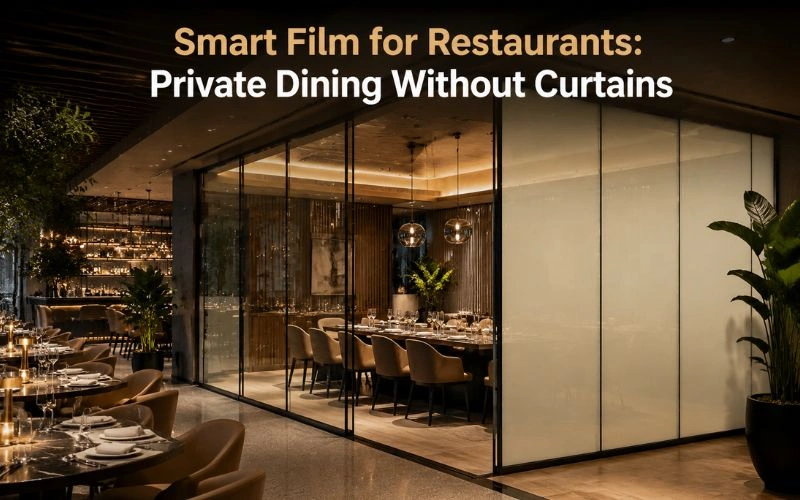
Saudi Arabia’s restaurant industry is one of the fastest-growing hospitality sectors in the region. From high-end fine dining venues in Riyadh’s diplomatic quarter to family restaurants across Jeddah’s coastline, competition for customers is intense, and the dining experience itself has become as important as the food on the plate. Ambiance, privacy, and atmosphere are no longer optional extras. They are the deciding factors that bring guests back and drive word-of-mouth reputation.
For restaurants looking to offer private dining without the dated look of heavy curtains or the permanent commitment of fixed walls, switchable privacy smart film has emerged as the most practical and visually impressive solution available in the KSA market today. A single switch transforms a glass partition from fully transparent to completely opaque, giving restaurants on-demand control over every dining zone without sacrificing the open, modern aesthetic that premium venues demand.
The problem with curtains and blinds is not just visual. Fabric dividers collect dust, require regular cleaning, limit airflow, and project an impression of a restaurant stuck in the past. Comparing smart film vs curtains makes the gap immediately obvious, smart film requires virtually no maintenance, integrates cleanly into modern restaurant interiors, and gives staff complete control over privacy from a wall switch, a remote, or even a smartphone app.
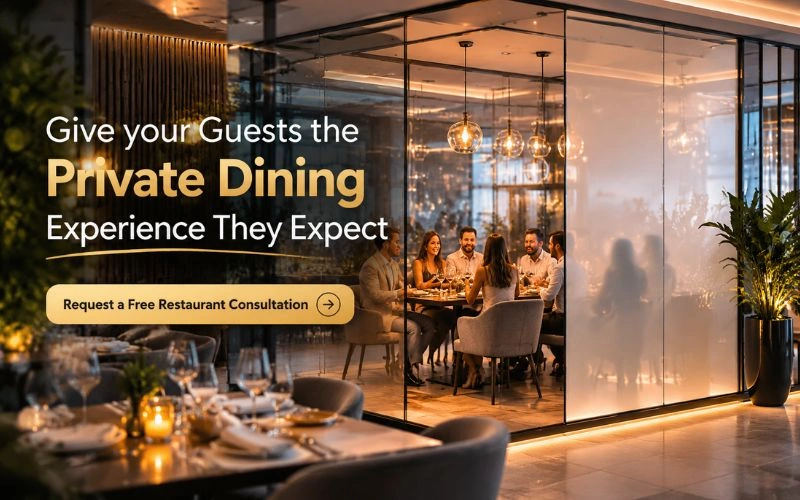
Why Private Dining Is a Priority for Saudi Restaurants
Saudi dining culture places a strong emphasis on privacy, family separation, and dedicated spaces for special occasions. Restaurants that fail to accommodate these preferences consistently lose bookings to competitors that do.
The Cultural and Commercial Case for Privacy
Family sections, private dining rooms, and VIP areas are not optional in the Saudi restaurant market, they are expected. Guests hosting business dinners, celebrating family occasions, or simply preferring a quieter environment actively seek out venues that can deliver a guaranteed level of seclusion. For restaurants that cannot offer this without bulky physical dividers, the booking volume reflects it directly.
The challenge is that fixed private rooms reduce seating flexibility. A restaurant cannot afford to have a dedicated six-seat private room sitting empty during a busy Friday evening rush. Smart film solves this entirely by allowing any glass-enclosed zone to function as either an open dining area or a fully private room depending on the moment’s demand.
How Smart Film Works in a Restaurant Environment
PDLC (Polymer Dispersed Liquid Crystal) smart film is a layer applied directly to existing glass surfaces. Powered on, it is completely clear. Powered off, it turns fully opaque within milliseconds. For restaurants, this means glass partition walls, booth dividers, private room enclosures, and even exterior-facing windows can all be controlled independently and instantly.
Installation Without Disrupting Operations
One of the most practical advantages of smart film for restaurants is how it is installed. Unlike frosted glass replacement or permanent construction, smart film is applied as a retrofit directly onto the existing glass. There is no need to close the restaurant for structural work, no construction mess, and no lengthy downtime. Most restaurant installations are completed within a single day. For busy venues that cannot afford extended closures, this is a decisive advantage over any alternative.
When comparing smart film vs frosted glass options, the retrofit capability alone often determines the choice, frosted glass requires full panel replacement, which means significantly higher installation cost and longer disruption to trading hours.
Key Benefits of Smart Film for Saudi Restaurants
Smart film delivers advantages that extend well beyond privacy. For restaurant operators managing ambiance, energy costs, and guest experience simultaneously, each benefit adds real commercial value.
Instant Privacy Zones Without Permanent Walls
With smart film installed on glass partitions, restaurants can create private dining zones that exist only when needed. A large family booking can have full seclusion for their celebration. A corporate group can conduct a business dinner without visual interruption from neighboring tables. When those bookings end, the glass returns to transparent and the space opens back up for general seating, all without moving furniture or calling staff to rearrange curtains.
A Clean, Modern Aesthetic That Strengthens the Brand
Premium restaurants in Saudi Arabia are investing heavily in interior design to match the expectations of an increasingly sophisticated dining public. Curtains and blinds undermine that investment. Smart film sits flush with the glass, invisible when not in use, and adds a technology-forward quality to the space that resonates strongly with younger, design-conscious guests. The visual impression alone, watching glass turn opaque at the touch of a button, creates a memorable moment that guests share.
Compliance With Family and Mixed-Seating Layouts
Saudi dining venues often need to maintain distinct family and singles sections in line with local customs and restaurant licensing requirements. Smart film allows these sections to be clearly delineated without constructing permanent walls that reduce layout flexibility. Section boundaries can be adjusted operationally as booking patterns change throughout the day or week.
Reduced Maintenance and Long-Term Cost Savings
Fabric curtains in restaurant environments face constant challenges, food odors, smoke absorption, staining, and the ongoing cost of professional cleaning. Smart film has no fabric components, requires no laundering, and cleans with a standard wipe-down. Over a three to five year period, the elimination of curtain maintenance costs alone represents a meaningful saving for busy restaurant operations.
Where to Apply Smart Film in a Restaurant
Smart film is versatile enough to work across multiple zones within a single restaurant, each serving a different operational purpose.
- Private dining room enclosures that open up to the main floor during peak hours
- VIP and family booth dividers for on-demand seclusion between adjacent seating groups
- Exterior-facing windows to manage afternoon glare and heat during daytime service
- Kitchen-to-dining viewing windows that can be made opaque during preparation or open for theatrical kitchen display
- Reception and waiting area glass to separate the entry experience from the dining floor
Saudi Arabia’s smart film performance in Saudi Arabia’s hot climate also matters here, restaurant windows facing direct sunlight create uncomfortable heat buildup near window seating, one of the most common complaints from guests during summer months. Smart film’s solar heat rejection properties, also available as a dedicated solar heat control film, address this directly, keeping window-adjacent tables comfortable and bookable throughout the day.
Smart Film in Hospitality Across Saudi Arabia
Restaurants are part of a broader hospitality ecosystem where smart film has already proven its value at scale. The same technology applied to restaurant partitions has transformed guest room privacy in hotels across the Kingdom. Hotels in Saudi Arabia have adopted smart film extensively for bathrooms, room dividers, and lobby areas, validating its durability and performance in high-traffic commercial hospitality environments.
For restaurant operators considering smart film alongside other window treatments, comparing smart film vs blinds is a useful starting point. Blinds are mechanical, require regular maintenance, and present a design compromise that smart film simply does not.
According to the Saudi Tourism Authority, the Kingdom’s hospitality and dining sector is projected to grow significantly as part of Vision 2030’s tourism targets, with restaurant quality and guest experience among the key drivers of that growth. Restaurants that invest in premium interior solutions now are positioning themselves directly for that expanding customer base.
What to Know Before Installing Smart Film in Your Restaurant
Every restaurant has a different layout, glass configuration, and operational schedule. The energy savings, privacy zones, and aesthetic improvements you achieve depend on how well the installation is planned around your specific space. Before committing to a project, this guide on what to consider before installing smart film covers the essential technical and commercial factors every Saudi restaurant owner should review.
Frequently Asked Questions
Is smart film safe for restaurant kitchens and hot environments?
Yes. Smart film is rated for standard commercial glass applications and holds up under normal kitchen heat and humidity. For very high-heat zones directly beside cooking equipment, our team assesses the specific glass location during the site survey to confirm suitability.
How long does smart film installation take in a restaurant?
Most single-restaurant installations are completed within a single day, since smart film is applied as a retrofit directly onto existing glass rather than requiring panel replacement or structural work.
Can smart film be controlled separately for each dining zone?
Yes. Each glass partition, booth divider, or private room enclosure can be wired to its own switch, remote, or app control, so staff can toggle privacy zone by zone rather than all at once.
Does smart film help with heat and glare near restaurant windows?
Yes. Beyond privacy, smart film reduces solar heat gain and glare on exterior-facing windows, which keeps window-adjacent tables comfortable and bookable even during peak Saudi summer heat.
Saudi Smart Solutions has completed smart film installations across restaurants, hotels, clinics, offices, and residential properties throughout Riyadh, Jeddah, Dammam, and all major KSA cities. Every project is handled by certified installation technicians, completed with minimal disruption, and backed by a comprehensive 5-year warranty. For restaurants ready to plan an installation, get in touch with our team for a site assessment and quote.